
The labour ministry on Friday appointed Tata Sons, promoter of the major operating companies of the Tata group, a knowledge partner for enhancing employability and entrepreneurship among the youth.

The mandate will help further the development agenda in these states, with good governance and policy reforms taking centrestage

In their pre-budget expectations, they also asked the government to assess the option of developing unused airstrips located in various parts of the country to boost air connectivity.
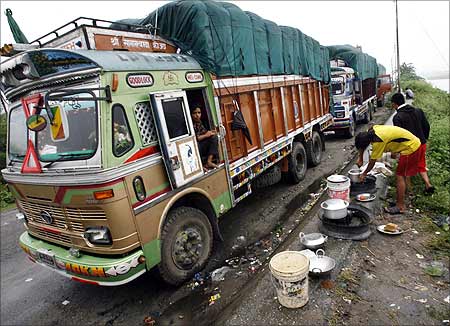
Implementation of GST is expected to increase the gross domestic product of the country.

Sharma, who has been regularly reviewing the situation with senior officials, has expressed concern over the drop in industrial performance in the recent months, the statement said.

Traders' body CAIT on Thursday urged the government to impose a ban on Amazon's e-commerce portal and its operations in India, accusing the global e-tailing giant of indulging in predatory pricing, deep discounting and inventory control. Addressing a press conference, CAIT secretary-general Praveen Khandelwal demanded an "immediate ban on Amazon's portal and its operations in India" and an investigation against the company in a time-bound manner. He also urged the government to probe the business practices of Amazon and Flipkart. However, responding to the allegations, both Amazon and Flipkart said they remain compliant with Indian laws.
CII suggested the policy measures required to ease the tight liquidity situation by cutting CRR by at least 50 basis points.
The meeting will focus on how to make the crisis an opportunity for India.
Corporates understand that the PMO drives all key decisions in this government.

So far, among the IBC cases, SBI has been able to recover Rs 8,500 crore from Tata Steel's acquisition of Bhushan Steel. Another Rs 1,500 crore is in an escrow account on account of Electrosteel Steels.
Companies are worried that any staggered roll-out of GST could result in cash flow issues with businesses not able claim tax credit due to breakage in the chain

The government was hoping to roll out the GST regime from April 2016.
While, projects, including Rs 23,000 crore Purvanchal Expressway, totalling Rs 60,000 crore have already been launched, the Yogi Adityanath government is fast paving the way for laying the foundation of the remaining projects before the general election dates are announced.

Lauding the pro-reforms approach adopted by Reserve Bank of India Governor Raghuram Rajan, industry body Confederation of Indian Industry on Thursday expressed the hope that the central bank would shift towards an expansionary monetary policy by cutting interest rates to stimulate growth.

The pandemic helped many entrepreneurs including me realise the power of people who share your passion, says fashion entrepreneur Meghna Saraogi.

Half a dozen names are doing the rounds as replacement for Cyrus Mistry as the chairman of the Tata Group.

Private firms will have to maintain a minimum net addition to their workforce each month from October this year to June 2021 to get the Employees' Provident Fund subsidy for the new recruits.

Modi has often been accused of promoting crony capitalism in Gujarat for his proximity to certain businesses.
Sitharaman also highlighted the steps taken by the government to achieve ease of doing business by digitisation of approvals and making more stable policies to make India a favourable destination for investors.

About 50 countries, including Canada, Mexico, Nigeria and Panama, have shown interest in having a Co-WIN like system to run their vaccination drive, a senior official said on Monday, adding India is ready to share the open source software free of cost.

The government hopes that the PLI schemes would provide 200,000-300,000 direct employment over five years, according to sources in the know.

According to India Skills Report 2019, Andhra Pradesh offers equal space to both male and female workers.
'Birla only made representations to then PM for coal blocks allocation.'

On the telecom sector, he demanded auctioning of more spectrum.

The Indian community in Australia and the Pacific will get an opportunity to contribute between India and countries in the region at the 7th Regional Pravasi Bharatiya Divas Convention in Sydney, a top Indian diplomat has said.
